 RICHARD DAVIS / DESIGN & AUTOMATIONRICHARD DAVIS / DESIGN & AUTOMATION
Over 20 years designing, building, and automating industrial and vehicle systems — SolidWorks CAD through to PLC programming, on projects from a single fix to full production lines.
| TITLE | Mechanical Design & Automation |
| DRAWN | R. DAVIS |
| SCALE | N.T.S. |
| SHEET | 1 OF 1 |
| REV | A |





The design and control work is still done properly, by hand, to the same regulations as always — the AI layer sits on top, speeding up iteration and catching things sooner.
Mechanical design and PLC programming aren't handled separately — the same person carries a project from the CAD model to the control logic that runs it, all to PUWER, LOLER, and Machinery Regulation (EU) 2023/1230.
A working portfolio — add a sheet for each project as it's completed.
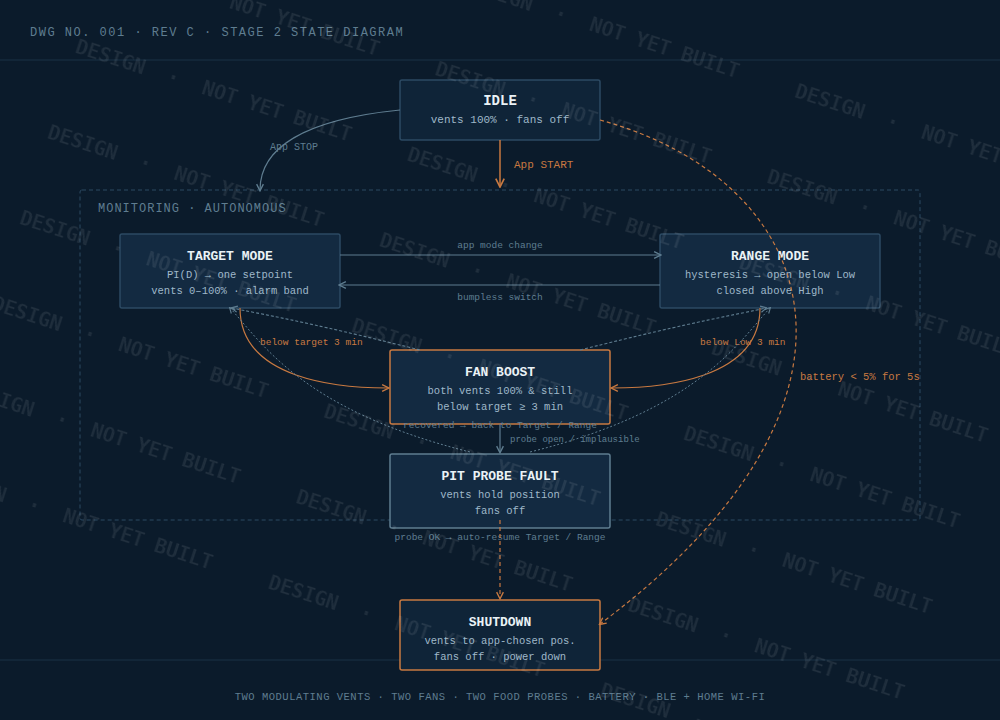
Final specification from a real Genesis session, taken through all eight stages — two modulating intake vents and two boost fans, switchable between PI(D) target control and the original hysteresis range mode, with food-probe alerts, low-fuel detection and battery-aware shutdown over BLE and home Wi-Fi. Design complete and reviewed; bench validation not yet built.
| 0 · INTAKE | Closed |
| 1 · DESCRIPTION OF OPERATION | Closed — final spec confirmed by client |
| 2 · PLC LOGIC | Closed, pending client sign-off on the logic itself |
| 3 · I/O DEFINITION | Closed — every I/O traces to Stage 2 |
| 4 · BENCH VALIDATION | Open — rigs designed, not yet built |
| 5 · HARDWARE ARCHITECTURE | Closed with flags — IP68 servo & fan sourcing still open |
| 6 · FIRMWARE TRANSLATION | Closed — ESP32-C6, ESP-IDF, control code verified against the ST |
| 7 · REVIEW & ITERATION | Closed — every Stage 1 requirement traced through |
| 8 · COST & TIME ESTIMATE | Closed |
(* =====================================================================
   BBQ VENT & FAN CONTROLLER — GENESIS STAGE 2 PLC LOGIC (rev C, FINAL SPEC)
   Two modulating intake vents, two boost fans, TARGET (PI(D)) and RANGE
   (hysteresis) control modes, food-probe alerts, low-fuel detection,
   battery-aware shutdown. Never compiled or run — see Stage 4.
   ===================================================================== *)


(* ---------------------------------------------------------------------
   FB: PI(D) controller for vent position, output 0..100 %
   Derivative on measurement; integrator clamped (anti-windup);
   bumpless initialisation to the current vent position.
   --------------------------------------------------------------------- *)
FUNCTION_BLOCK PID_Vent
VAR_INPUT
    SP      : REAL;     (* target temperature, deg C *)
    PV      : REAL;     (* pit temperature, deg C *)
    Kp      : REAL;     (* % vent per deg C *)
    Ti_s    : REAL;     (* integral time, s (0 = no integral) *)
    Td_s    : REAL;     (* derivative time, s *)
    dt_s    : REAL;     (* sample interval, s *)
    Init    : BOOL;     (* TRUE = bumpless start from InitOut *)
    InitOut : REAL;     (* current vent position, % *)
END_VAR
VAR_OUTPUT
    Out     : REAL;
END_VAR
VAR
    I       : REAL;
    PrevPV  : REAL;
    E       : REAL;
    D       : REAL;
    U       : REAL;
END_VAR

    E := SP - PV;
    IF Init THEN
        I      := InitOut - Kp * E;
        PrevPV := PV;
    END_IF;

    IF Ti_s > 0.0 THEN
        I := I + Kp * dt_s / Ti_s * E;
    END_IF;
    IF I > 100.0 THEN I := 100.0; ELSIF I < 0.0 THEN I := 0.0; END_IF;

    D := -Kp * Td_s * (PV - PrevPV) / dt_s;
    PrevPV := PV;

    U := Kp * E + I + D;
    IF U > 100.0 THEN U := 100.0; ELSIF U < 0.0 THEN U := 0.0; END_IF;
    Out := U;

END_FUNCTION_BLOCK


(* ---------------------------------------------------------------------
   FB: one vent channel — servo + closed-end position sensor
   Checks position only where the single sensor can prove it:
     target <= 0.5 %  -> sensor must read closed
     target >= 10 %   -> sensor must read NOT closed
     0.5..10 %        -> no check (sensor ambiguous near closed)
   On a failed check: back off to 50 %, re-approach once, then fault.
   --------------------------------------------------------------------- *)
FUNCTION_BLOCK VentChannel
VAR_INPUT
    Demand      : REAL;     (* 0 = closed (bleed) .. 100 = fully open *)
    AtClosed    : BOOL;     (* TRUE = vent at closed end *)
    MoveTime    : TIME;     (* allowed time for a full stroke *)
END_VAR
VAR_OUTPUT
    ServoPos    : REAL;     (* position command to servo, % *)
    Moving      : BOOL;
    PosFault    : BOOL;     (* "Vent N failed to reach position" *)
    FullyOpen   : BOOL;     (* settled at >= 99.5 % with no fault *)
END_VAR
VAR
    Step        : INT := 1; (* 0 settled, 1 moving, 2 back-off, 3 re-approach *)
    Target      : REAL;
    FirstScan   : BOOL := TRUE;
    MoveTmr     : TON;
    PositionOK  : BOOL;
END_VAR

    IF FirstScan THEN
        Target    := Demand;
        FirstScan := FALSE;
    END_IF;

    IF ABS(Demand - Target) > 0.1 THEN
        Target := Demand;
        MoveTmr(IN := FALSE);
        Step   := 1;
    END_IF;

    IF Target <= 0.5 THEN
        PositionOK := AtClosed;
    ELSIF Target >= 10.0 THEN
        PositionOK := NOT AtClosed;
    ELSE
        PositionOK := TRUE;
    END_IF;

    CASE Step OF
        0:  ServoPos := Target;

        1:  ServoPos := Target;
            MoveTmr(IN := TRUE, PT := MoveTime);
            IF MoveTmr.Q THEN
                MoveTmr(IN := FALSE);
                IF PositionOK THEN
                    PosFault := FALSE;
                    Step := 0;
                ELSE
                    Step := 2;
                END_IF;
            END_IF;

        2:  ServoPos := 50.0;              (* back off *)
            MoveTmr(IN := TRUE, PT := MoveTime);
            IF MoveTmr.Q THEN
                MoveTmr(IN := FALSE);
                Step := 3;
            END_IF;

        3:  ServoPos := Target;            (* single retry *)
            MoveTmr(IN := TRUE, PT := MoveTime);
            IF MoveTmr.Q THEN
                MoveTmr(IN := FALSE);
                PosFault := NOT PositionOK; (* warning only; keep commanding target *)
                Step := 0;
            END_IF;
    END_CASE;

    Moving    := Step <> 0;
    FullyOpen := (Target >= 99.5) AND (Step = 0) AND NOT PosFault;

END_FUNCTION_BLOCK


(* ---------------------------------------------------------------------
   MAIN PROGRAM — modes, both control strategies, fan boost, alarm band,
   low fuel, food probes, battery shutdown, servo power switching, LED.
   Full I/O list and tuning table are in the Genesis project document —
   condensed here for the works sheet.
   --------------------------------------------------------------------- *)
PROGRAM BBQ_Vent_Fan_Control
VAR_INPUT
    (* From app: BLE or home Wi-Fi *)
    CmdStart, CmdStop       : BOOL;
    ControlMode             : INT := 1;   (* 1 = TARGET, 2 = RANGE *)
    PitTarget               : REAL := 110.0;
    AlarmLow, AlarmHigh     : REAL := 100.0, 125.0;
    RangeLow, RangeHigh     : REAL := 105.0, 120.0;
    Food1Enable, Food2Enable: BOOL;
    Food1Target, Food2Target: REAL := 95.0, 95.0;
    CriticalVentPos         : REAL := 0.0;  (* vent position at 5% battery *)

    (* From hardware *)
    PitTemp, Food1Temp, Food2Temp   : REAL;
    PitProbeOpen, Food1ProbeOpen, Food2ProbeOpen : BOOL;
    V1_AtClosed, V2_AtClosed        : BOOL;
    BatteryPct                      : REAL;
END_VAR
VAR_OUTPUT
    Vent1Pos, Vent2Pos      : REAL;
    ServoPowerEn            : BOOL;   (* servo rail on only while moving *)
    Fan1On, Fan2On          : BOOL;   (* per-vent interlock: never without its vent fully open *)
    ShutdownReq             : BOOL;
    ModeState               : INT;    (* 0 IDLE, 1 MONITORING, 2 SHUTDOWN *)
    StartRejected           : BOOL;
    Fault_PitProbeDisconnected, Fault_PitReadingImplausible : BOOL;
    Fault_Food1Probe, Fault_Food2Probe                      : BOOL;
    Fault_Vent1Position, Fault_Vent2Position                : BOOL;
    Warn_BatteryLow, Alert_BatteryCritical                  : BOOL;
    Alert_PitHigh, Alert_PitLow, Alert_LowFuel              : BOOL;
    Alert_Food1Near, Alert_Food1Done                        : BOOL;
    Alert_Food2Near, Alert_Food2Done                        : BOOL;
    StatusLEDOut            : BOOL;   (* off / steady / 1 Hz blink on fault *)
END_VAR
VAR
    State           : INT := 0;       (* not retained across power loss *)
    VentDemand      : REAL := 100.0;
    Kp              : REAL := 4.0;    Ti_s : REAL := 600.0;
    MoveTime        : TIME := T#3S;   FanDelay : TIME := T#3M;
    LowFuelWindow   : TIME := T#10M;  LowFuelMinDrop : REAL := 2.0;
    PID             : PID_Vent;
    Vent1, Vent2    : VentChannel;
    (* internals: sample timer, probe-jump check, fan/band/low-fuel
       timers, shutdown timer, servo-off timer, LED blink timer — see
       the full listing in the Genesis project document *)
END_VAR

    (* Pit probe validity: open-circuit OR out of plausible range OR
       a jump > 25 deg C in one 1 s sample *)
    Fault_PitProbeDisconnected  := PitProbeOpen;
    Fault_PitReadingImplausible := NOT PitProbeOpen
        AND ((PitTemp < -20.0) OR (PitTemp > 600.0) /* OR PitJump */);

    (* Mode control: IDLE -> MONITORING on App START, guarded by valid
       settings, a healthy pit probe and battery >= 5%. SHUTDOWN pre-empts
       everything once battery stays below 5% for 5 s. *)
    CASE State OF
        0:  (* IDLE: vents 100%, fans off *)
            VentDemand := 100.0;
            IF CmdStart AND NOT CmdStop THEN
                (* SettingsOK AND PitProbeOK AND battery >= 5% -> State := 1
                   else -> StartRejected := TRUE *)
            END_IF;

        1:  (* MONITORING: TARGET runs PID_Vent every 1 s sample; RANGE
               is the open-below-Low / closed-above-High hysteresis.
               Either mode drives FAN BOOST once both vents are fully
               open and the pit is still below target/Low for FanDelay.
               A pit probe fault holds the vents and stops the fans,
               with automatic resume once the probe is healthy again. *)
            ;

        2:  (* SHUTDOWN: vents move to CriticalVentPos, fans stop, a
               final alert goes out, ShutdownReq after 15 s *)
            ;
    END_CASE;

    (* Vents: one VentChannel FB each, closed-end position check with
       one back-off-and-retry. Servo rail switched on only while moving,
       +0.5 s, to save battery. *)
    Vent1(Demand := VentDemand, AtClosed := V1_AtClosed, MoveTime := MoveTime);
    Vent2(Demand := VentDemand, AtClosed := V2_AtClosed, MoveTime := MoveTime);
    Vent1Pos := Vent1.ServoPos;   Vent2Pos := Vent2.ServoPos;

    (* Fans: per-vent interlock — a fan never runs unless its own vent
       has reached fully open *)
    Fan1On := (State = 1) AND Vent1.FullyOpen /* AND FanReq */;
    Fan2On := (State = 1) AND Vent2.FullyOpen /* AND FanReq */;

    (* Food probes: near/done alerts in any state, fault on disconnect *)
    Alert_Food1Done := Food1Enable AND NOT Food1ProbeOpen AND (Food1Temp >= Food1Target);
    Alert_Food2Done := Food2Enable AND NOT Food2ProbeOpen AND (Food2Temp >= Food2Target);

END_PROGRAM
A structured, staged process for replacing a PLC with a custom-built controller — starting from a genuine blank slate and ending in a fully proven, documented design.
An illustrative walk-through of the tool — step through it below with a sample system (a tank fill with a pump interlock). Your own system gets asked through the same process before anything's drawn.
That's the logic worked out — and it's already clear this isn't a small job. Interlocks, fault behaviour, the physical build, getting it actually running on real hardware — that's the part that needs a proper conversation, not a demo.
Try it for realA digital twin dashboard that reads straight out of the SolidWorks model and drives it against a live PLC in real time, through a single master tag register — no manual re-entry between CAD and control.
The front end works — this is a real dashboard driving a real PLC, not a mock-up. The self-serve version isn't open yet, so for now it's delivered the same way the rest of my work is: hands-on, project by project.
Ask about thisAlready a client? Access your project space — files, comments, and progress in one place.
Client loginSend over what you're working with — a sketch, a spec, or just a description of the problem. I'll look it over and reply with next steps. If you'd rather talk it through first, you can book a call once you've sent your enquiry.
Got it — I'll look over what you've described. If you'd rather not wait for a reply, grab a slot directly:
Book a call